
My review of Adolf Peter’s book on EU sustainability law and supply chains has been published in the Asian International Arbitration Journal. I think it is worth your time, so I reproduce it here.
Reprinted from Asian International Arbitration Journal Volume 22, Issue 1 (2026) pp. 85 – 90, with permission of Kluwer Law International.
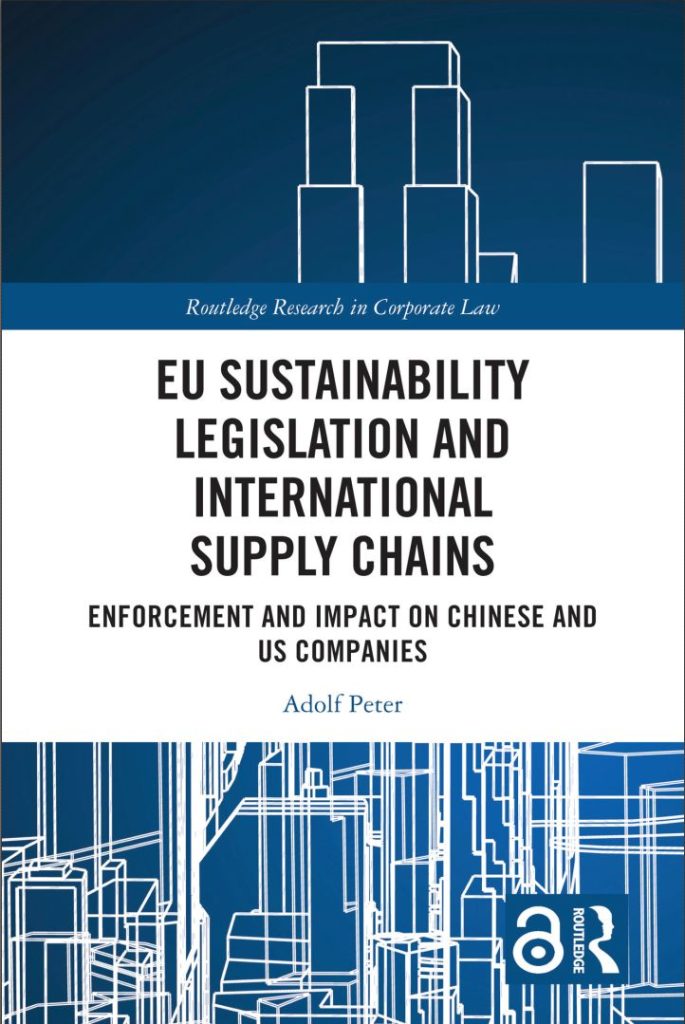
EU Sustainability Legislation and International Supply Chains: Enforcement and Impact on Chinese and US Companies, Adolf Peter, London/New York: Routledge. 2025. 378 pp. £155 (hardback), open access (online). ISBN 9781032563626.
The EU is a peculiar organisation that believes in ever closer cooperation and sometimes takes big steps without considering the consequences. This is why Europe gave itself a single currency while stubbornly ignoring the disparate economic strengths and debt levels of its Member States, resulting in the eurozone crisis. Similarly, the EU has abolished internal border controls without adequately securing its external borders, thus enabling largely uncontrolled immigration.
Die Zeit 25/2025 [1]
I began my reading of EU Sustainability Legislation and International Supply Chains: Enforcement and Impact on Chinese and US Companies with the above quote from German weekly Die Zeit fresh in mind. It struck me how the observation about the EU’s bold but sometimes uncritical steps (from the eurozone to Schengen; the General Data Protection Regulation was not even mentioned) resonates with today’s rush to regulate environmental, social, and governance (ESG) issues and international supply chains. In a world where Europe leads the charge in corporate sustainability law, this book’s timing is superb. From the first page, I appreciated that Adolf Peter, an Austrian law professor based in Shanghai, tackles these issues head-on.

EU Directives: CSDDD, CSRD and Their Enforcement
Chapter 1 dives deeply into the heart of EU law on corporate sustainability. The author meticulously lays out the new Corporate Sustainability Due Diligence Directive (CSDDD) alongside the Corporate Sustainability Reporting Directive (CSRD) and related measures (the Deforestation Regulation, the Forced Labour Regulation, and the Green Claims Directive). He identifies which companies fall within the directives’ scope and catalogues their duties and sanctions. He also discusses the many ongoing debates over the CSDDD’s provisions (sometimes leaving unresolved whether certain obligations might be relaxed or delayed).
The chapter also explores enforcement and liability. The author devotes attention to how EU civil judgments for CSDDD breaches could be recognised and enforced abroad, highlighting China and the United States as key examples. Similarly, the chapter examines the roles and potential liabilities of company directors and boards under the CSDDD: for example, it outlines how directors’ duties are viewed in Austria and contrasts this with the frameworks in China and the US. One clear strength of the book is already apparent here: its practicality. If you have a question about applying the CSDDD or CSRD, there is a good chance you will find at least an initial answer within its pages. The author even ventures into forward-looking ideas, such as a tax-based incentive to reward companies that contractually bind their value-chain partners to year-on-year decarbonisation. This kind of proposal makes the book stand out. That said, I have a minor reservation: while harmonising with global standards is appealing, defining ‘adverse impacts’ by reference to external treaties could create legal uncertainty and invite yet more judicial interpretation and layers of bureaucracy on top of an already vast compliance framework.
Global Perspective: China and the US
The second chapter zooms out to compare international approaches. The author candidly observes that neither China nor the US has enacted standalone laws quite like the CSDDD or CSRD. Instead, he provides a useful overview of existing frameworks for comparative purposes. On the US side, the analysis is thorough: it chronicles how various federal and state actions have recently tended to roll back or negate ESG requirements, often for political reasons. This section is impressively detailed – perhaps more than one might need for a high-level overview, given how swiftly US policy can change these days. By contrast, the section on China is more concise. The author shows that China’s sustainability regulation is primarily established through stock exchange rules and certain corporate law provisions. Though shorter, this section hits the key points without overwhelming the reader, highlighting regulatory guidance and evolving corporate governance standards in shaping sustainability compliance. It also notes the practical limits of enforcement, particularly the difficulties associated with recognition of European judgments in China. These observations are especially valuable for non-Chinese practitioners, as they temper expectations about formal legal convergence while offering a realistic account of how compliance pressures are likely to operate on Chinese companies in practice. Taken together, the comparative sections on the US and China serve to contextualise the EU’s reach: one comes away appreciating how uniquely ambitious the EU’s legislation is, and why these new rules will have ripple effects across global supply chains.
Contractual Cascading and Remedies
Chapter 3 addresses how the new due diligence duties can and should cascade through contracts in a supply chain. The author explains ‘contractual cascading’ – a term that did not make it into law – via twelve real-world case studies (including Shell, RWE, and Heineken) from various jurisdictions (the Netherlands, Germany, Austria, and others). These cases set the stage for sample contractual clauses proposed later in the chapter. Notably, these clauses are framed in common law terms (such as representations, warranties, liquidated damages, and indemnities) as the primary enforcement mechanism for the environmental and human-rights provisions. I admire the thoroughness of this exercise; it gives specific guidance on writing ESG obligations into contracts. However, given that the CSDDD and the CSRD are creations of European law, and that many affected companies will operate under civil law contracts, I was mildly puzzled by the chapter’s sole reliance on common law remedies. Civil law systems permit contractual penalties, which could be a highly effective means of enforcing ESG duties, yet these are only introduced in the following chapter. This technical difference felt somewhat awkwardly split between chapters, even though the author’s undertaking of the subject is otherwise comprehensive.
Climate Obligations and Model Clauses
Chapter 4 builds on the previous chapter by focusing on climate commitments. The argument is clear: since the largest multinationals (the primary targets of the CSDDD/CSRD) account for the vast majority of global emissions, embedding climate targets in contracts is critical. The author surveys the relevant instruments: not only the CSDDD’s own requirement for a climate transition plan (with Scope 1, 2, and 3 greenhouse-gas targets), but also the EU Emissions Trading System and the Carbon Border Adjustment Mechanism. The chapter then turns to international examples, such as California’s cap-and-trade programme, the US’ Regional Greenhouse Gas Initiative, China’s national emission trading scheme, and even developments in the automotive sector (including Formula 1), showing how climate obligations are (or are not) addressed around the world.
This chapter also includes climate-specific model clauses for contractual cascading. Notably, it tackles the distinction between ‘liquidated damages’ and civil-law ‘contractual penalties’, which the previous chapter had only hinted at. I still think it might have made more sense to discuss this technical distinction alongside the other remedies in chapter 3. Nevertheless, the exposition here is clear. We learn, for example, how to draft clauses for year-on-year decarbonisation targets and what kind of transition-plan commitments the major companies might incorporate.
Arbitration and ESG Enforcement
The fifth chapter boldly considers whether arbitration could help enforce ESG duties along international supply chains. At first glance, this seems counterintuitive: arbitration is consensual, so in a multi-tier chain one would need a web of compatible arbitration agreements and mechanisms (consolidation, joinder, etc.) to bring all parties together into a single proceeding, ideally. The author confronts this challenge head-on. He explains how such chain-wide arbitration clauses would require carefully calibrated consolidation and joinder provisions, and he even provides sample arbitration clauses designed to cascade into a chain of activities.
There are many constructive elements in this chapter. The author suggests, for example, that arbitral institutions might adopt CSDDD-specific rules and maintain lists of arbitrators who are experts in ESG matters. A memorable rallying call is that ‘International commercial arbitration will play a significant role in CSDDD-related disputes involving multiple parties from the chain of activities.’ Whether this optimism is justified remains to be seen, but it is inspiring to think big.
That said, the chapter does have its quirks. Midway through, it detours into a discussion of how claims under the United Nations Convention on Contracts for the International Sale of Goods (CISG) might relate to ESG disputes – a section that feels somewhat out of place in a chapter focused on arbitration. Also, the author surveys consolidation and joinder clauses in the rules of various institutions, though I noticed that the latest arbitration rules of the Arbitration Institute of the Stockholm Chamber of Commerce (SCC) and the German Arbitration Institute (DIS) were omitted – a curious gap given their relevance within the EU. These are relatively minor points in what is otherwise a rich and insightful chapter.
Perhaps my main practical reservation is this: in complex supply chains, it is very difficult to ensure that every contract contains a compatible arbitration agreement, particularly where the supply chains are multi-layered, meaning that a party enters into more than one contract with its immediate neighbour in the chain. Many practitioners (myself included) suspect that well-resourced courts, rather than arbitral tribunals, might ultimately handle these complex disputes more effectively. The numerous commercial courts that have recently emerged in many jurisdictions come to mind. This would be especially true if the international recognition and enforcement of court judgments were further strengthened, for example through the Hague Convention of 30 June 2005 on Choice of Court Agreements. This convention is currently in force in the EU and all its Member States (including Denmark). It has not yet entered into force in China or the US, due to the absence of ratification.
Conclusion
In summary, EU Sustainability Legislation and International Supply Chains: Enforcement and Impact on Chinese and US Companies is an impressive and timely contribution to the field. I would highlight the following features in particular:
- An exhaustive analysis of the CSDDD and CSRD, covering scope, duties, and enforcement challenges;
- a global perspective that compares the EU’s approach with frameworks in China and the US;
- practical tools in the form of case studies and model contract clauses that translate duties into real contracts; and
- a brave venture into novel territory, such as detailed climate clauses and the role of arbitration in ESG disputes.
My reservations are minor: a bit too much detail on recent US developments, some editorial choices about where certain discussions sit (such as the treatment of liquidated damages), and there remain fair questions about how far arbitration can realistically go. But these points do not significantly diminish the book’s overall achievements. If anything, they highlight how thought-provoking the work is; it is a mark of quality that this volume invites discussion and debate rather than offering simple answers. Above all, I admire the sheer scope and depth of this work. It will serve as an essential reference in the evolving field of sustainable corporate governance. In an area where the law struggles to keep pace with ethical and environmental demands, this book provides insight, and a wealth of new ideas. I congratulate the author on this substantial achievement. It is to his credit that reading this book feels like joining a learned conversation – one I am eager to continue.

[1] Translated by me. Original wording:
Die EU ist ein seltsames Gebilde, das im Glauben an ein immer engeres Miteinander bisweilen große Schritte wagt, ohne die Konsequenzen zu bedenken. Deshalb hat sich Europa eine eigene Währung gegeben – aber hartnäckig ignoriert, dass die Wirtschaftskraft und die Verschuldung in den Mitgliedsstaaten so weit auseinanderlagen, dass daraus eine Euro-Krise entstehen konnte. Ganz ähnlich hat die EU die Grenzkontrollen in ihrem Innern abgeschafft – ohne die Außengrenzen angemessen zu sichern. Und damit eine weithin unkontrollierte Zuwanderung ermöglicht.
Reprinted from Asian International Arbitration Journal Volume 22, Issue 1 (2026) pp. 85 – 90, with permission of Kluwer Law International.
Leave a Reply