
In March 2026, I presented a paper at the 23rd International Congress of Maritime Arbitrators (ICMA XXIII) in Singapore on recovering the cost of preventing a loss from a contractual breach that has not yet happened. The paper has now been published, in expanded form, in the German transport law journal Transportrecht: ‘The Cost of Prevention – Expense Recovery in Maritime Logistics Under German Law, Correctly Applied’, TranspR 2026, 296–302 (issue 7–8) (subscription required).
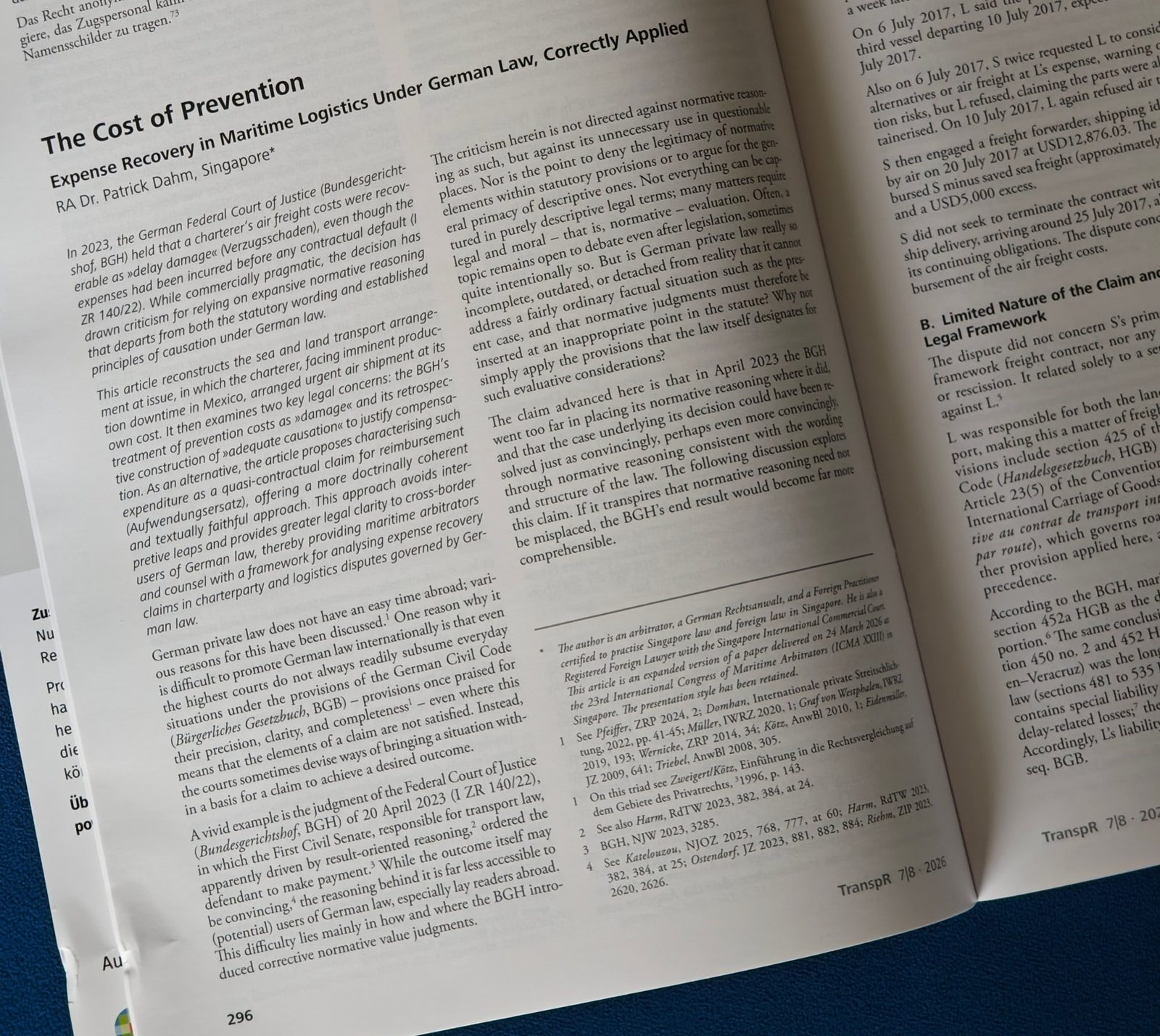
The facts: parts a charterer needed for its factory in Mexico were plainly not going to arrive by sea in time, and production there was about to stop. The charterer arranged an urgent air shipment of replacement parts at its own cost. The money was spent before any contractual default by the carrier. The German Federal Court of Justice (Bundesgerichtshof) nevertheless held it recoverable as delay damage, or Verzugsschaden (BGH, 20 April 2023 – I ZR 140/22).
The outcome is commercially pragmatic, but the route to it is not. Prevention costs are treated as ‘damage’, and ‘adequate causation’ is then invoked to justify compensating them. Both are terms of art, but neither is being used in its settled sense. Worse, the causal analysis is built backwards from the result.
What I propose in the article is a different characterisation. Money spent to avert a loss is not damage but expenditure, and German law already has a home for it in the quasi-contractual claim for reimbursement of expenses under the law of negotiorum gestio (Geschäftsführung ohne Auftrag). That route reaches the same commercial destination without the interpretive leaps, and it gives cross-border users of German law a result they can predict. It also has the advantage of making sense – ontologically, linguistically, and legally.
The distinction – expenses rather than damages – is not peculiar to German law, and that is what I expand on at the end of the article. The relevant decision of the Singapore Court of Appeal, if only by way of obiter dictum, is The ‘Asia Star’ [2010] SGCA 12 at [24]: ‘the aggrieved party cannot recover avoidable or avoided loss; it may, however, recover expenses reasonably incurred in the course of taking mitigation measures.’
Precisely. Recover expenses, not damages.
Leave a Reply