When it comes to holidays, I have a long, unwritten list of places I’d like to go, some easier to reach than others: Portugal, for instance, where I’ve never been. Or Georgia, Uzbekistan, that part of the world. Anywhere, really, that promises to be interesting. Even in Germany there are still corners that call to me.
Bosnia and Herzegovina, I must confess, was not on the list. But when I floated Istanbul this year, the best wife in the world said, ‘No. Sarajevo. And Mostar.’ So in October, that’s where we went. And what can I say? It was an excellent decision. (Istanbul is merely a pleasure deferred.) Here are a few reflections on our trip.
I’d heard of Sarajevo and Mostar, of course. And not only because of the dark chapter the whole country went through in the nineties (more on that later). The first time I heard the name Sarajevo, I was nine: Vučko, the mascot of the 1984 Winter Olympics, was singing it on television. Good times.
Shout-out to my old mate Peter, who could do a masterful impression of it.
A still from that clip is sold as a magnet all over town. I bought one, and it now graces our fridge door at home.
There are no direct flights from Singapore to Sarajevo. The usual routes go via Dubai, Istanbul or – talk about going round the houses – Frankfurt or Zurich. We opt for Dubai, which I’d never much rated as a transit hub. Coming from Asia, whenever a stopover was unavoidable, I used to prefer getting one long flight over and done with (ideally asleep), followed by a short hop to the actual destination. This time it’s different. Stretching my legs for a while halfway through the journey, lounging on a sofa with a coffee and a sandwich, suddenly appeals to me. A change of heart. The halfway stopover: I’ll bear that in mind in future.
The plan is to spend four days in Sarajevo, then two days and a night in Mostar, followed by another four days in Sarajevo. Looking back, I can say it worked out beautifully. Our base camp in Sarajevo is a guest room right in the heart of Baščaršija, the historic Ottoman bazaar and old town, whose alleys seem like a maze at first, though we soon find our way around.
About that guest room. Let me say up front that this post is not sponsored, and I’m not beholden to anyone. But I’d like to put it on record that the Baš Čaršija Boutique Place guesthouse is a real gem. A guesthouse, not a hotel. Our room: squeaky clean. Lejla, the owner, is a fantastic host, helpful and approachable. Highly recommended for anyone staying in Sarajevo.
Sarajevo, as everyone knows, is chock-full of history. You run into it at every turn. It starts before we’re even properly there: on the drive in from the airport, we pass the Office of the High Representative for Bosnia and Herzegovina, that legal and political anomaly of an institution, created under the Dayton Agreement in 1995. The High Representative is chosen by a handful of foreign governments, not by the country’s own citizens, and can impose laws and dismiss elected officials. Meant as a temporary arrangement, the office is still here more than thirty years on.
After arriving and unpacking – it’s afternoon by now – we head out for a first stroll, meant only to get our bearings, not yet to delve into the past. But straight away we stumble upon the spot where, on 28 June 1914, Gavrilo Princip shot Archduke Franz Ferdinand and his wife Sophie – the assassination that sparked the First World War. Surely no visit to Sarajevo is complete without seeing it. Well, that’s that ticked off, quite inadvertently.
Later, when we visit the city hall, an exhibition will tell us exactly why the archduke and his wife were in Sarajevo, what they were doing here, even what made their marriage so unusual, and much more besides.
The architectural and cultural cornerstones of Baščaršija are its mosques, though sadly, because of all the tourists, most of them stay closed until just before prayer time. Beyond the mosques, Baščaršija is largely cafés and restaurants serving local food at every price. Our guidebook lists a few, and they’re mostly still right, but the book is more than four years old. The internet helps. More helpful still is a text from Lejla listing places to eat for every eventuality. We choose a restaurant right on the bank of the Miljacka: Inat Kuća, the House of Spite. It’s so called because the house once stood on the opposite bank, where the Austro-Hungarian authorities wanted to build the city hall (known as the Vijećnica). The owner refused to sell until the authorities promised to move the whole building stone by stone across the river, which they did in 1895. Now it sits directly opposite the city hall it once blocked, and it has been a restaurant since 1997. Classic Bosnian cooking – exactly what we’re after. We tuck in. After that, we’re done for the day. It’s been a long journey.
We form first and second impressions of the country and its people. Unscientific and entirely personal, of course. Among them: Bosnia and Herzegovina, a majority-Muslim country, is Muslim in a very relaxed – dare I say European – way. That suits me. Also: people smoke a lot. And the taxi drivers are all of a type: about my age, built like a nightclub bouncer, and the kindest, chattiest company you could wish for. Every one of them a gentle giant.
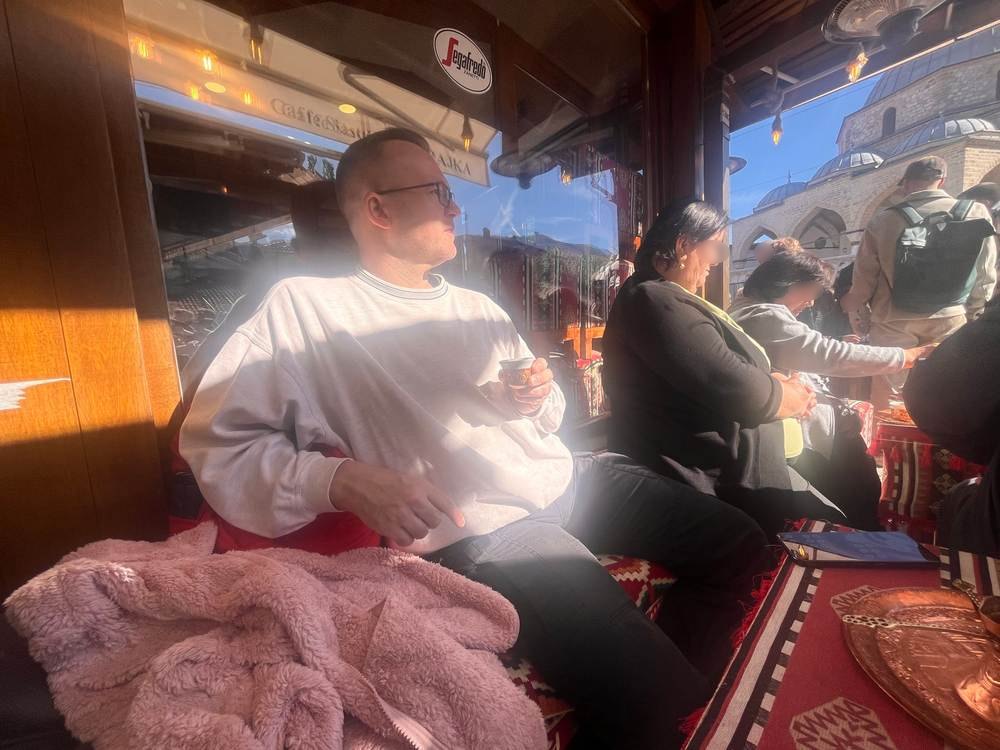
The next morning, we sit in a café in glorious sunshine. I close my eyes and let the atmosphere wash over me. The sun, the coffee, the sound of the city. It dawns on me how much I had missed Europe – southern Europe!
I drink Bosnian coffee, obviously, as I do every day from then on, though after a few days I add the odd espresso or ‘Americano’. Thankfully, the way they make the ‘Americano’ here, the crema stays intact every single time, as God intended, because they add the espresso at the end, so it’s clearly not an Americano but a long black. But I’ll let that one go, seeing as I’m on holiday and I’m not a petty or pedantic person.
The other big chunk of Baščaršija is souvenir shops, with bakeries and bureaux de change in between. Mostly you can’t pay by card, which, for a fan of cashless payment like me, goes down an absolute treat. And – a frequently asked question, apparently – you can’t pay in euros either.
We’d read about this beforehand, so we’ve come prepared, with euros that we change into local currency here. As expected, the money changers won’t take Singapore dollars.
That local currency is the convertible mark (KM), pegged 1:1 to the Deutschmark until 2001, which makes converting and paying a nostalgic pleasure for someone like me who remembers the DM days. The five-mark coin even looks like the old DM one, with a big, bold 5 on it.
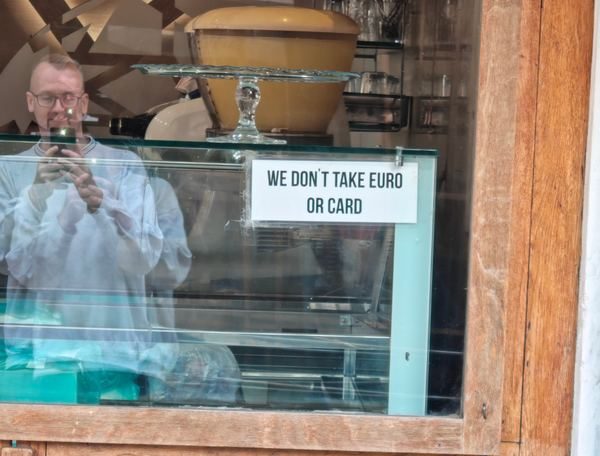
The lack of cashless payment is a symptom of something else, something bigger: automation takes a back seat here. Not just payments: every service is provided first and foremost by flesh-and-blood people. It’s refreshing. Don’t get me wrong – it’s 2026, and of course Bosnia and Herzegovina has automated processes. What I don’t see, though, is human interaction being replaced entirely by a machine. How different from Singapore! As Singapore automates more and more of daily life, we’re losing something important. I don’t think that’s particularly smart.
Which brings me to ćevapi and burek. Until now I’d only known ćevapi as ćevapčići (‘little ćevapi’), from visits to Yugoslav restaurants many moons ago. Basically, grilled minced beef in various sizes. I celebrate our reunion in style by eating them for breakfast every day – well, for the first few days at least. And burek? Thin, flaky rolls of pastry with various fillings such as meat, cheese, spinach or potatoes, which, being German, I naturally knew in its Turkish form, börek. In Sarajevo, it’s the cottage cheese version that has won my heart.
Man shall not live by meat alone, and I now have a favourite bakery too: Pekara Imaret, which, as everyone will tell you, has been supplying the city with baked goods since 1531 (!). Channelling our inner hobbits, we go there almost every day after breakfast for second breakfast. That wouldn’t end well in the long run.
Surrounding Baščaršija is what I would call the rest of Sarajevo’s city centre. Its architecture is Austro-Hungarian. The buildings are taller, there’s more stone than wood, and everything has the look of a European city centre; at a quick glance you could be on a pedestrianised street in Hamburg or Munich. The contrast is neatly marked by the Sarajevo Meeting of Cultures line on the pavement of Ferhadija Street.
I could easily go on and on about all the lovely things we experience. But where is the right place to talk about the war?
The Bosnian War of 1992 to 1995 was part of the Yugoslav Wars of 1991 to 2001. Yugoslavia – which I had come to know as the home of a primary school classmate and as a potential holiday destination (my gran had been there now and then) – broke up in the nineties, and its parts then turned on one another. Today, after countless books, newspaper articles, analyses and war crimes tribunals dealing with a war that claimed well over a hundred thousand lives – not to mention the millions who fled their homes – we’re all wiser, or so we like to think. But I still remember sitting in front of the television in Germany at the time, the Tagesschau evening news on, wondering what the hell was suddenly going on – and, above all, why?! I also remember many Yugoslavs (ex-Yugoslavs?) in the news reports and documentaries of the time asking the very same question. At school we made awkward jokes about three made-up characters called Serbić, Kroatić and Bosnić, forever squabbling over heaven knows what.
In Sarajevo, the traces of the war are impossible to miss. For almost four years the city was encircled by the Bosnian Serb army, which meant being cut off from electricity, water and food supplies and living under constant artillery and sniper fire (Sniper Alley – google it). Its lifeline was a secret tunnel dug under the airport runway: Tunel spasa, the Tunnel of Salvation. Graves in parks, dug when the cemeteries proper were too dangerous to reach under shelling from the surrounding hills and mountains. Scars of war on many buildings. Damaged façades, bullet holes, shrapnel marks. The so-called Sarajevo Roses: shell craters in the tarmac, filled with red resin, vaguely reminiscent of roses shedding their petals, in places where people were killed by the blast.
As a visitor, I’m immediately struck by how the open – or at best superficially painted-over – wounds of war sit side by side with the trappings of a modern city. But I wonder how much the war, visible as it is, still figures in the everyday lives of Sarajevans, especially the younger ones. The end of the Bosnian War is now further in the past than the end of the Second World War was when I was born.
There’s no shortage of museums on the subject. We buy a combined ticket for three of them. First, we visit the Museum of Crimes Against Humanity and Genocide. It is as harrowing as it sounds. We get talking to the man who sells the tickets and runs the museum shop, a young Sarajevan. No matter that his job keeps him immersed in the war all day; we talk about it, about Bosnia today, the EU, Germany, everything.
Straight afterwards: the Sarajevo 80s Museum next door – perhaps not by coincidence – a soothing contrast with its eighties and Eastern Bloc vibes, which remind me of my family’s visits to friends in East Germany. The colours, the everyday objects, the lingo of Tito’s socialist self-management. Only the next day do we go to the third museum on our ticket, the Siege of Sarajevo Museum, which deals with the 1,425-day siege of the city and with life – and death – during that time. Broadly speaking, many of the facts aren’t new to me; I must have soaked up more of the news coverage at the time than I realised. It’s the grim new details that devastate me.
I buy a slim but gripping book, which I read over the following days: Amir Telibećirović and Sabaha Čolaković, The Siege of Sarajevo 1992–1996.
A few days later, while looking for the cable car entrance in the dark, we visit another war museum, the Ratni muzej, or War Museum 1992 Sarajevo. The focus here, as far as I can tell, is more on the fighting. Or what passes for fighting when you’re under siege.
A note: I didn’t want to leave the war in the former Yugoslavia out of this post, or gloss over the dark-tourism side of our trip. But I haven’t gone into it in any detail either. It deserves more attention, and frankly more depth, than I can give it in a travel post.
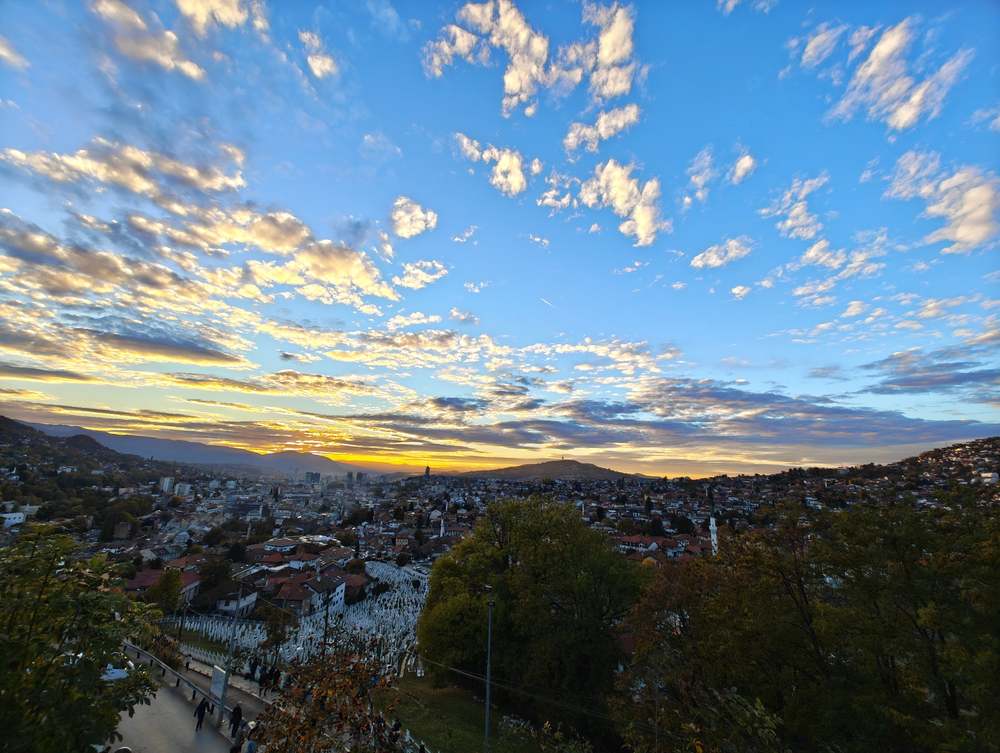
We head up to the Yellow Fortress, also known as the Yellow Bastion, an 18th-century cannon fortress from even earlier conflicts, a little further up the hill. The view of the city from there is said to be phenomenal. Social media wasn’t lying.
It was on social media, too, that we came across a trend: on the way up, you stop at another bakery-cum-pizzeria called Pekara Kovači kod Mahira, pick up a pizza, carry it up to the fortress and eat it there before sunset. Trend or not, I think it’s a brilliant idea, and so I hike up to the fortress lugging a massive sixteen-inch pizza box – nothing smaller would do, naturally.
Heh, a quick digression, because I always think of this whenever sixteen-inch pizza comes up. Does anyone still remember Rocky’s Pizza at the Rail Mall in Hillview? At the start of the millennium, when I was going back and forth to Singapore, at times flying in every six months or so, it was a ritual of mine to order a sixteen-inch white pizza from Rocky’s the moment I landed – a homecoming of sorts. You did that by phone back then. The pizza was just ridiculously good and sometimes (rarely) even lasted two days. But what really made it was the way the people at Rocky’s, no matter how long I’d been away, always recognised my number and greeted me by name as soon as they picked up. ‘Hello, Patrick. The usual?’
I miss Rocky’s Pizza at the Rail Mall. Digression over.
When we reach the Yellow Fortress, it’s pretty crowded; the approaching sunset against the truly stunning backdrop of the valley draws plenty of tourists, but we bag a good spot. Nobody else here has pizza.
Another day, another place: a café in front of the Sacred Heart Cathedral, where we sit outside looking at the cathedral over coffee and ice cream. It’s my fourth coffee of the day, and I’m not enjoying it. So now I know my daily coffee limit.
Suddenly: noise! Uproar! The sound of an agitated crowd. It’s the march of the ‘Horde Zla’, the ultras of FK Sarajevo, who are playing their local rivals FK Željezničar tonight. A local derby! I quickly check online whether there are any tickets left. Probably not, it says, but you never know. The club shop is nearby. But because kick-off is fairly late and we have an early start tomorrow (the trip to Mostar beckons), we give it a miss. Judging by the reports, we miss a passionate match – but no matter: the flares let off by the ultras hold up play for more than half an hour. By the sound of it, we wouldn’t have been back in our room until after midnight, with a mandatory rise-and-shine at 4.30 am.
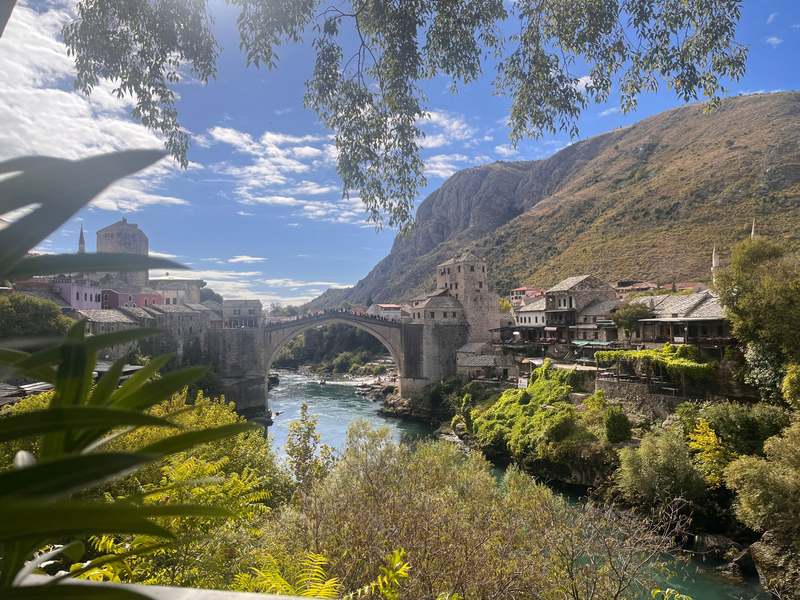
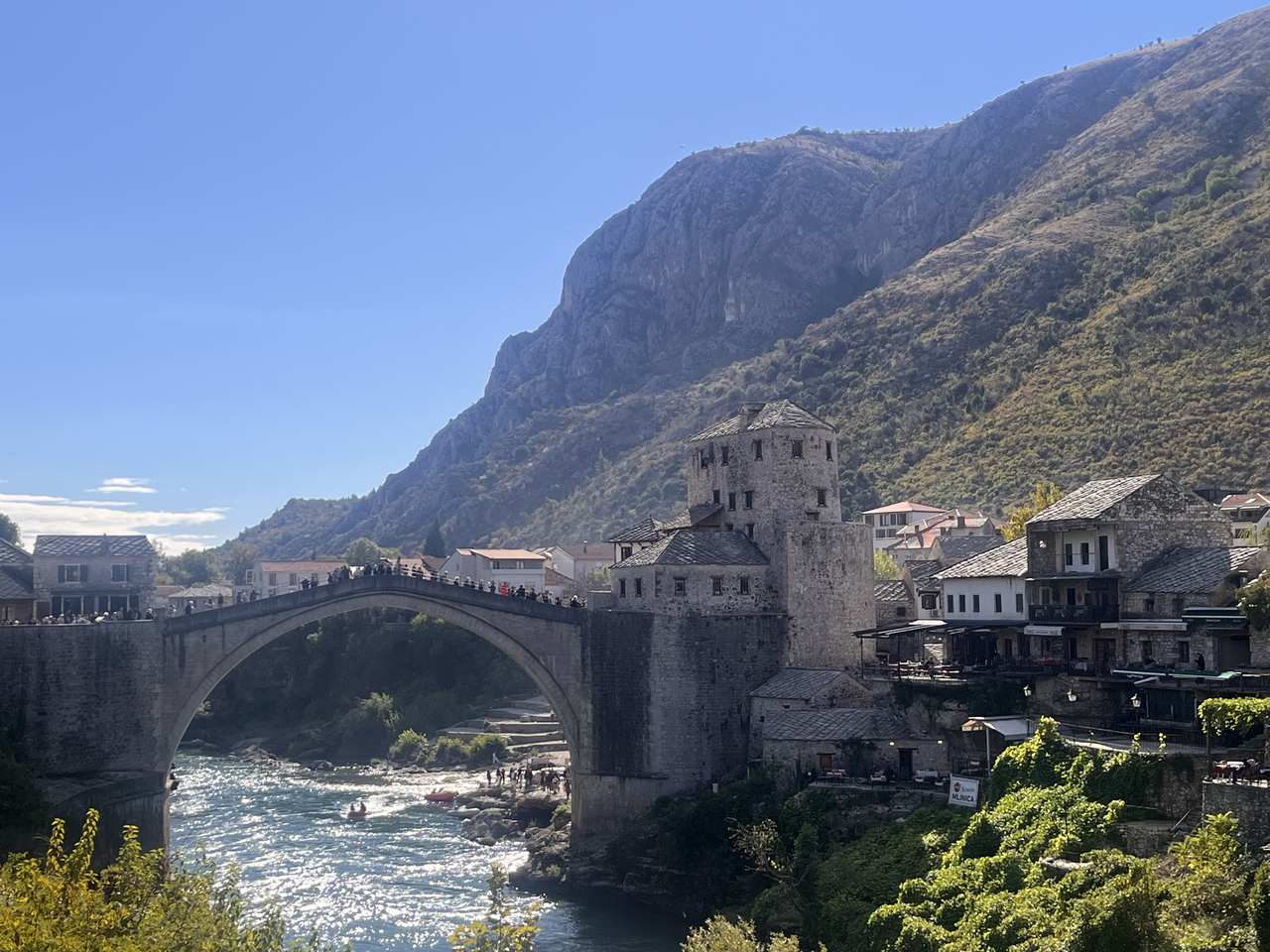
Mostar, the largest city in Herzegovina, the southern part of the country, is a two-hour train ride from Sarajevo. For many people the name conjures up the city’s landmark, the Old Bridge (Stari Most) over the River Neretva, destroyed in November 1993 by the HVO, the Bosnian Croat army. I remember the pictures on German television; that was how I first heard of Mostar. The bridge was rebuilt between 2001 and 2004 and is now a UNESCO World Heritage Site.
Everyone, the man at the ticket office included, tells you that on the way from Sarajevo to Mostar you should sit on the left, facing forwards, for the best views – and the other way round on the way back, of course. Dutifully, we take seats on the left; the way the seats face bears us out, and so do the seat numbers. The train jolts into motion – and goes backwards. We’re sitting the right way; the train’s going the wrong way! Luckily, I find the view, pretty though it is, not quite as spectacular as we were promised. On the way back it’s dark, so which way we sit doesn’t matter anyway.
We walk from the station to the old town, twenty minutes or so. We pause at a cemetery where all the headstones (and there are many) bear the same year of death: 1993.
By ten in the morning the old town is already overrun with tourists. (Yes, I know we’re part of the problem.) This is how I imagine Venice, and Dubrovnik, and Barcelona. Most of them are said to be day-trippers (off the train from Sarajevo, naturally), which is why some travel writers recommend staying the night if you want to experience Mostar in peace – that is, before and after the hordes. That’s what we do, and it’s another good call.
I find a breakfast spot where you can escape the crowds for a while, with a stunning panoramic view of the River Neretva, the Stari Most and the rest of the old town, as well as Mount Hum. It’s late October, but the sun on the terrace is so warm that I take off my jacket and woolly jumper and sit there in a T‑shirt.
Our hotel in Mostar, the Hotel-Restaurant Kriva Ćuprija, is a lucky find. From the outside: Rivendell vibes (had Elrond built in dark stone). Several levels and storeys on the hillside, with a rushing mountain stream running through the grounds. Inside: given a modern makeover, so you can’t hear the stream with the window closed (important). Lovely restaurant, lovely people.
The pleasant atmosphere and the good food (which go hand in hand, of course) put my mind at rest, because I’d been slightly worried that this hotel would turn out to be a dud. On the interwebs there are recent reviews praising the place to the skies alongside older ones warning people off. Could the positive reviews have been bought?
Chatting with the hotel staff, I mention this, and Janet, the duty manager that day, tells me that new management only recently took over the business. Before that, an elderly couple had run the hotel-restaurant, not for profit but to promote tourism in Mostar. But age had made it increasingly hard for the two of them to keep it all going. The new management, she says, is nowhere near done with the changes it has planned. Updating the website, for instance (true, that could do with some attention), will have to wait until the off-season; during the season there simply isn’t time.
It all sounds entirely plausible and squares with our impressions. We’re very glad that we struck lucky with our choice of accommodation here, too. Traveller, should you come to Mostar, you may stay here!
Shortly after six the next morning, we’re standing on the Old Bridge. We really do have it all to ourselves, apart from a huge dog sleeping the sleep of the just at the highest point of the bridge – the very spot where tourists tread on each other’s toes during the day – undisturbed by all our snapping away. The morning sun glitters on the water, the air is crisp, the old town spreads out before us.
Back to the hotel for breakfast. Afterwards – by now we’re far from the only people about – we head to the Koski Mehmed Pasha Mosque, a 17th-century Ottoman mosque beside the River Neretva, and you can climb its minaret, so we do. Even more panoramic views of the Stari Most and the river. The narrow minaret balcony is only thirty metres up, but it feels much higher because the Old Bridge and the river valley lie so far below. With the parapet barely reaching my hips, I feel a little queasy, and I’m glad to head back down.
In Mostar’s old town, by the way, the unofficial currency is the euro – quite obviously to cater for the tourist hordes. Prices for tourist knick-knacks and tat are also much higher than in Sarajevo. Card payment is more common, too. We spend the day sightseeing, including an interesting documentary about the historically and architecturally faithful reconstruction of the bridge. In the afternoon we take the train back to Sarajevo for the third and final leg of our trip.
Our last days in Sarajevo are more of the same. By now we know our way around Baščaršija; we have favourite restaurants and cafés but stay curious and open to new things. In other words, we eat and drink an awful lot.
Honourable mention in all this: Aščinica Hadžibajrić, a restaurant serving slow-cooked Bosnian food and one of the entries on Lejla’s list. Although it’s in Baščaršija, it isn’t geared towards tourists. It’s run like a canteen, and the menu is in Bosnian only. English? Well, all right, they speak it for our benefit, but otherwise there are only locals, spooning up tomato soup and tucking into meatballs. On our second visit, a reserved smile of recognition; on our third, the owner tells us about the history of the family business, which, we’re told, goes back more than 160 years (!).
We buy souvenirs – or, more accurately, the best wife in the world buys them, because when I try, I’m often hit with a white man surcharge or something, the kind I’m used to from Singapore and elsewhere in Southeast Asia. Before she goes into a shop, she hisses at me to make myself scarce, so she won’t be seen with me. It works. She buys things they’d tried to sell me earlier for nearly twice as much.
On the morning of 29 October, while we’re still in our room, Patrick Stewart’s official Instagram account announces his death. At first, I refuse to believe it.
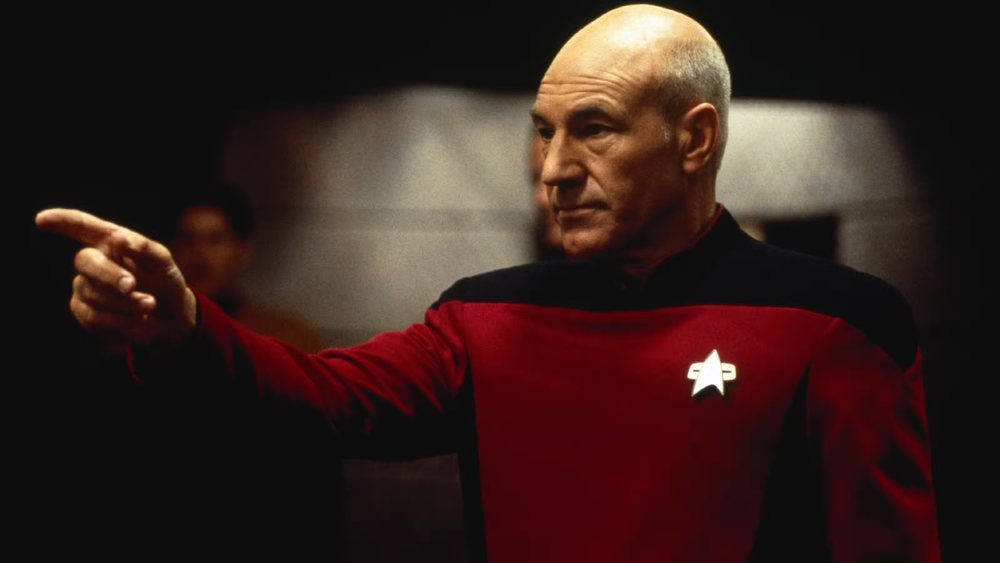
Star Trek shaped generations of nerds, and in Patrick Stewart they have lost Jean-Luc Picard: a hero of their childhood and youth. Captain, later Admiral, Picard was a protagonist who would rather talk than shoot, and was usually right about what needed saying. To me, man and character alike were and always will be – in the words of Picard’s frenemy Q – mon capitaine.
The day before we leave, the cable car up Trebević is finally running again after several days of maintenance. Trebević is the mountain on Sarajevo’s southern edge, on whose slopes the 1984 bobsleigh and luge events were held. You can walk down the now-abandoned, graffiti-covered bobsleigh track, and so we do. The mountain is ‘only’ 1,628 metres high, but all the zigzagging on the way down adds up to a solid 9.7 kilometres. A bit of muscle ache afterwards. Rather a lot, actually.
One last dinner at Inat Kuća. Late the next morning, a taxi takes us to the airport. ‘Please come back to Sarajevo’, says the big man at the wheel. Gladly. Then it’s back home to Singapore.
The day after we get back, we fancy ayam penyet for dinner. There are a couple of restaurants at a shopping centre near us where we like to go for it. One of them has been refurbished. Now, here too, you order and pay at a touchscreen terminal by the entrance. Inside, the food arrives by robot. The contrast with the human interaction we enjoyed in Bosnia and Herzegovina could hardly be greater. It leaves us, to put it mildly, with a sense of loss. I know, I know: manpower shortage, labour costs and all that. Even so. We in Singapore are doing ourselves no favours with this.
As they’d say in Bosnia: e, jada!
Leave a Reply